
Can Structural Castings be improved?⚒️
How to solve the issues of low silicon alloys in HPDC

This weeks newsletter contains the following topics:
Revisit: Pumping up Aluminium Alloys
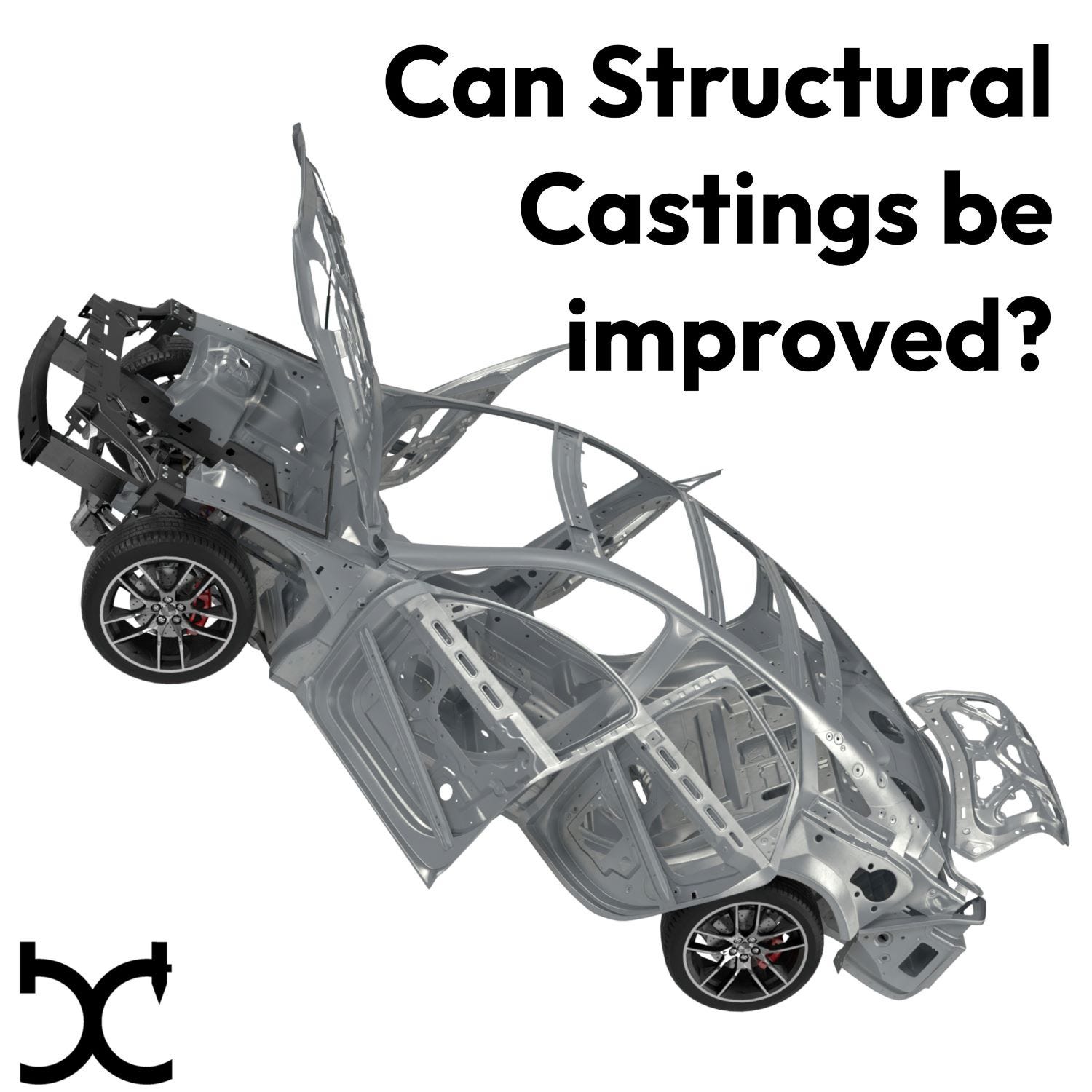
Structural castings are the home turf of the AlSi10MnMg. This universal alloy has been used for decades with its excellent castability. Most castings, from small brackets to large longitudinal members, are made from this alloy.
The processing is always the same. After melting and casting, the part goes into the heat treatment line. A two-step heat treatment is required to achieve the high ductility necessary for crashworthiness. Alloys close to the eutectic point form many pointy silicon needles during solidification. They need to be rounded in the heat treatment, which requires a minimum of 30 minutes above 440 degrees for a thin-walled casting.
After the solutionizing step, the part is quenched with air or water. During the quenching, the part's residual stresses deform it. These stresses come from casting, cooling, trimming, or mounting inside the heat treatment rack. Afterwards, this requires complex multi-dimensional straightening.
Latest HPDC Trends
As parts grew bigger and bigger, culminating in Gigacasting, many OEMs started to use lower silicon, naturally ageing alloys, like the AlSi7MnMg. This brings several issues in the HPDC process. In HPDC, the castability is higher, with a smaller solidification range. So, the closer you are to the eutectic point, the better the castability.
That alloy is further away from that point and has a larger solidification interval. That requires longer feeding times through the gate to avoid shrinkage porosity. Another issue is that melt fronts with different temperatures often cannot recombine and leave bi-films inside the casting. You’ll find them with luck in a tensile test and pretty quickly in a leakage test (if that is a requirement, e.g. battery castings)
In addition, the AlSi7MnMg alloy tends to stick and solder onto the die steel at high metal speeds. Thus, it's not ideal for a large casting that needs to be filled quickly.
The Solution?
In Rheocasting, the silicon content does not define castability as long as the solidification interval is large enough. So, the AlSi10MnMg is not castable in Rheocasting. The AlSi7MnMg works fine. That solves the castability issue. Also, because of the thixotropic properties, you can make the part slower to avoid the soldering problems, especially after adjusting the ingate for the Rheocasting process. Another advantage is that you have a more laminar and consistent cavity filling, which avoids many quality issues of the HPDC part.
The kicker? You can fit the same casting on a smaller machine, reducing operating costs. In addition, due to the lower slurry temperature and the slower filling, erosion is drastically lower. This will be reflected in longer tool lifetimes!
Doesn't that sound great? All you have to do is buy a slurrymaker, modify the ingate and overflows to the Rheocasting process and adjust the chemical composition within the specification of the AlSi7MnMg. You get a wonderfully quality headache-free casting!
In the Rheocasting Workshop from Casting-Campus GmbH, you can learn more about using Rheocasting to enhance your existing portfolio and access new markets.
Conference Speaker Announcement⚒️
Casting-Campus is proud to announce that Fabian Niklas will be one of the speakers at the Austrian Foundry Conference (Österreichische Gießereitagung). The presentation is called “Rheocast away”, and the background of the announcement video is key to the content. However, the presentation has nothing to do with the sand itself.
“What has a tropical paradise to do with the foundry industry?” might be your question. And if you want to have the answer, visit the conference.
The conference will be held on April 24 and 25 in Leoben, where I studied. It is great to have such an opportunity to return, and I look forward to meeting you there! However, I also know that, as this conference is in German, a language my followers don’t speak, I won’t be able to listen. I will have an English version of my presentation available after the conference for those who cannot attend. Sign up for the newsletter so you do not miss it!
For those who speak German, check out the rest of the program. It contains interesting presentations, such as those from the ÖGI – Österreichisches Gießerei-Institut, the Montanuniversität Leoben, voestalpine Additive Manufacturing, MAGMA Gießereitechnologie GmbH, Rheinfelden Alloys GmbH, Fill, and many others.
Just follow the link to the ÖGI website and register your attendance at the Austrian Foundry Conference:
Marketing is the Key to Industry Success⚒️
The die-casting industry has to gear-up in both technology and marketing activities. Foundries must adapt to new business opportunities, rethink traditional models, and attract talent to expand die-casting applications.
A key takeaway is that foundries must embrace flexibility when entering new industries. In telecom, die-casting faced missed opportunities due to rigid business models. Many foundries failed because they imposed automotive-driven practices onto a different sector. Instead of listening carefully and adapting to industry-specific demands, they stuck to standard procedures, losing potential markets. A customer-centric approach is crucial for success.
Die-casting has traditionally been volume-driven, with margins dictated by efficiency, machining services, and strategic material purchasing. However, growing global competition and price pressures threaten profitability. To sustain margins, foundries must evolve beyond volume-based strategies by offering design input, innovation, and additional services.
When Quality and Lean Management kills Innovation
Excessive overhead from quality and lean management processes is a major challenge. While necessary, over-specification, such as extreme porosity standards, leads to wasted resources and higher costs without tangible performance benefits. Foundries face bureaucratic slowdowns, excessive documentation, and unnecessary inspections, making them less agile and competitive.
Many non-European competitors operate with leaner structures, allowing faster iterations and customer response. If European companies want to survive, they must reassess how these processes serve the business rather than hinder it.
Traditionally reactive, the die-casting industry must now drive innovation. Engineers introducing casting to new applications to demonstrate how proactive engagement can open markets. Instead of just responding to demand on the portals, foundries should educate customers on casting’s advantages and new possibilities.
The Industry Needs a Mindset Shift
Many foundries still expect customers to understand HPDC instead of making it accessible. This inward focus disadvantages them, as unfamiliar engineers default to sheet metal or other methods. To succeed, foundries must position themselves as development partners, engaging OEMs at the concept stage, hiring engineers who advocate for casting, and investing in R&D to showcase potential.
For casting to secure its future, marketing must be flexible and proactive. Foundries must adapt strategies for different industries, maintain margins by offering more than raw castings, and attract professionals who expand applications. Most importantly, they must shift from being passive suppliers to strategic development partners.
With technology, expertise, and demand on their side, HPDC foundries have what it takes to thrive. However, without a marketing transformation and streamlined management practices, they risk losing ground to more adaptable manufacturing methods. The time for change is now.
Thank you for listening. We’ll see you in the next episode, where we’ll continue to bring you the latest insights and updates from the casting world. Don’t forget to ask questions, comment, or suggest future episodes.
Offers from Casting-Campus GmbH
Casting-Campus is all about helping you acquire new business through intelligent solutions, new technologies like Rheocasting, and sustainability.
Our services start in positioning your foundry. The next steps are to find unique solutions to market to existing and new customers and generate new profitable castings. In the meantime, we will improve your internal processes to accommodate the new solutions in your foundry. During the sampling process, we’re by your side, pushing the buttons to deliver the properties promised in the development process
Workshops on HPDC process optimization, Rheocasting and Sustainability
Business Development to acquire new Customers in the Foundry Industry
Strategy Development for Rheocasting and Sustainable Castings
Casting Experts on Demand - The Netflix of Knowledge
Support for part development: address casting issues early in the design process
Cut Energy costs and produce Sustainable Castings
If this sounds appealing to you, visit the website for more information on the Consulting Services and schedule a Free Consultation Call. Let’s discuss what is the right solution for your topic of interest:
Historical Post
A weekly reminder of an old but gold article
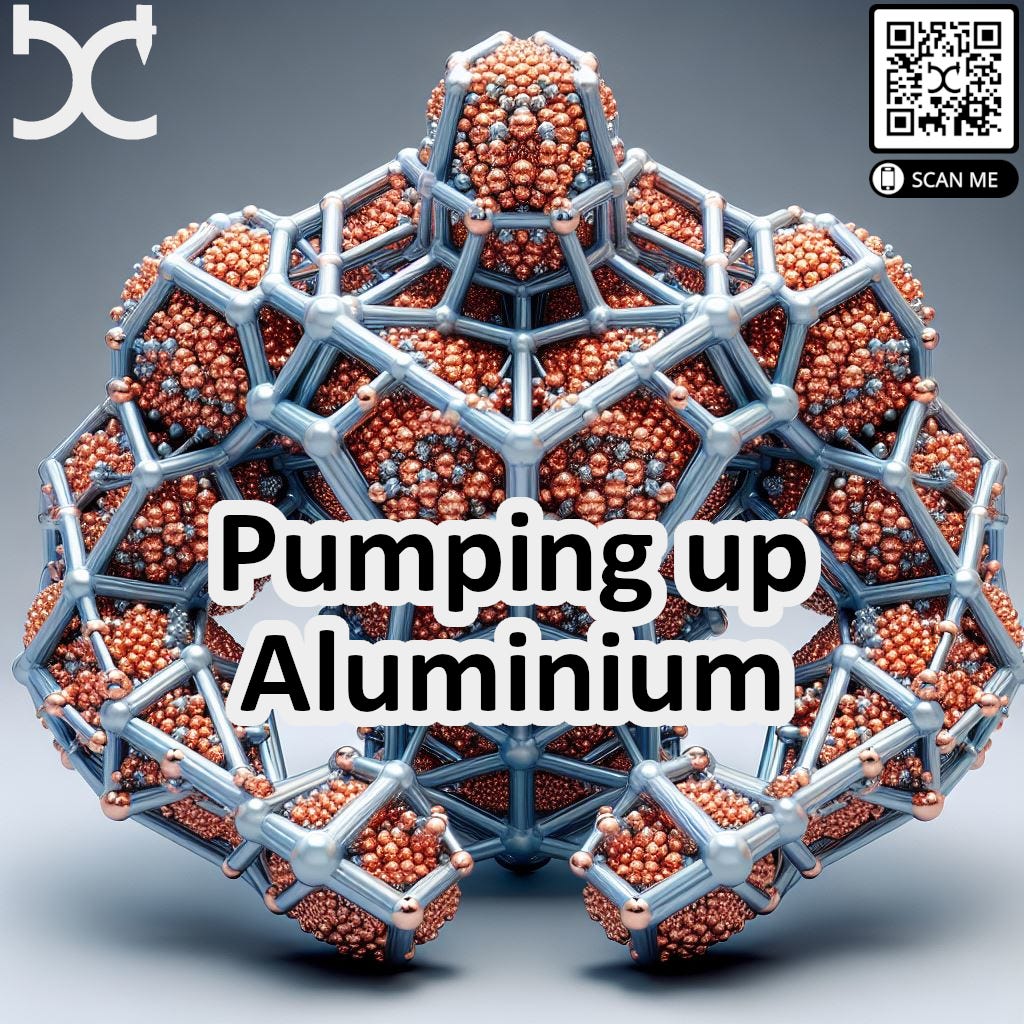
Pumping up Aluminium Alloys⚒️
Pure aluminium-silicon alloys' mechanical properties are unsuitable for automotive applications. The chemical composition must be modified to increase strength without sacrificing elongation.
There is only one way to increase strength and elongation simultaneously. Grain refinement is the magical word. Refining the grain structure can mitigate the undesirable effects of coarse eutectic silicon particles and large primary α–Al grains. Dislocations - I'll explain them in a second - also cannot bridge the grain boundary to the next grain.
The grain size in HPDC is quite similar and is only impacted by the die's cooling capabilities and the casting's wall thickness. Here comes the role of the alloying elements: Magnesium, Zinc, and Copper. They provide substantial increases in strength and facilitate precipitation hardening.
These elements increase strength through Guinier–Preston (GP) zones, which are small precipitations inside the aluminium matrix. GP zones are associated with the phenomenon of age hardening, whereby room-temperature reactions continue to occur within a material over time, resulting in changing physical properties. As the alloy naturally ages, its ductility will decrease. That is why the ageing process is often sped up through heat treatment. Fine precipitates are formed during the heat treatment, increasing the alloy's hardness.
The hardness increases as the resistance against deformation increases. Behind this effect are dislocations, which are two-dimensional crystal defects that play a crucial role in the deformation of aluminium alloys.
Dislocations move through the grains by applying an external force. When such a dislocation reaches a GP zone, it is stopped. Higher stress is needed to move it forward, either climbing around the precipitation or cutting it. This is the effect behind higher strength and lower elongation. So, it is always a trade-off between elongation and strength.
Just adding these three elements isn't beneficial. Zinc and copper also have negative effects.
Zinc never stops its natural ageing process, with its self-diffusion temperature at -10°C. This leads to changing properties over the years in the alloy and attached substances, like glue.
Copper delivers a high strength increase, especially after a T6 heat treatment. It is also famous for corroding the Cu2 Phases. The Cu2+ ions can accelerate pitting corrosion in the presence of chloride ions.
For most structural castings, both elements are limited to 0.03 to 0.05%. This low content reflects the negative aspects. With that low amount of corrosion and ageing, problems are negligible. However, this challenges recycling facilities in producing sustainable HPDC alloys.
If you have any more questions or need further clarification, book your Process Optimisation Workshop focussing on the Alloy and its processing!