
How to design Alloys for Function and Footprint⚒️
Learn how an alloy change impacts the Functionality and the Sustainability

This week’s newsletter contains the following topics:
Do you know what is the most significant contributor to a casting's CO2 footprint?
The majority of the emissions come from the alloy. The smelting process from bauxite via alumina to aluminium requires a lot of electrical power. It takes around 17.000 kWh of electricity to manufacture 1 ton of pure aluminium. So, it comes down to the electricity that the carbon footprint of an alloy is. According to the International Aluminium Institute, worldwide, 50% of the energy comes from coal power plants. Around 10% comes from natural gas plants. A third comes from hydro power, and around 6% from other renewable energy sources. Only 0.5% comes from nuclear power plants.
60% of all new or primary aluminium comes from burning stuff, which generates a lot of greenhouse gas emissions. In addition, mining operations, transport, and electrodes also emit a lot of CO2.
Are Secondary Alloys the solution?
When using secondary alloys to make new alloys, the energy-intensive primary route seems unnecessary. However, specifications add a twist. Aluminium is a non-noble metal. Processing routes for steel and copper alloys are unusable for aluminium, as the aluminium would be removed instead of the impurities.
So, every element in the aluminium scrap will be in the final alloy. The vast majority of casting scraps are made of high copper and iron alloys like 226 (46000, AlSi9Cu3) or A380 (AlSi8Cu3). You can easily remelt them to make the same alloy. However, the demand for parts goes down constantly. For high-performance alloys for structural body-in-white parts or thermal management applications, these scrap streams are unusable. The specifications limit iron and copper contents just above their natural limits.
However, there are other scrap streams that are perfectly usable for these high-performance alloys, and they help reduce the carbon footprint a lot. The global average carbon footprint is around 16 kg CO2e per kg Al, and the best primary alloys are around 4 kg CO2e per kg Al. The average primary alloy is around 1.9 kg CO2e per kg Al. That is a significant reduction in emissions.
Everything is perfectly fine with these secondary alloys, except that all OEMs want their parts made with increasing percentages of high-quality post-consumer scraps. So, everybody is running towards the same exit, which causes the scrap prices to explode. It will become the norm that secondary high-performance alloys are more expensive than primary ones, as suitable scrap is traded at a premium.
How to break out of the Spiral?
The easy answer to a complex problem is to change the alloy. Many foundries hate this solution because it adds complexity to their processing. However, sometimes real change is needed. When choosing an alloy that utilises scrap streams unsuitable for the current alloys, you can reduce the carbon footprint far below 1 kg CO2e per kg Al. You can also design the alloys to enable new properties.
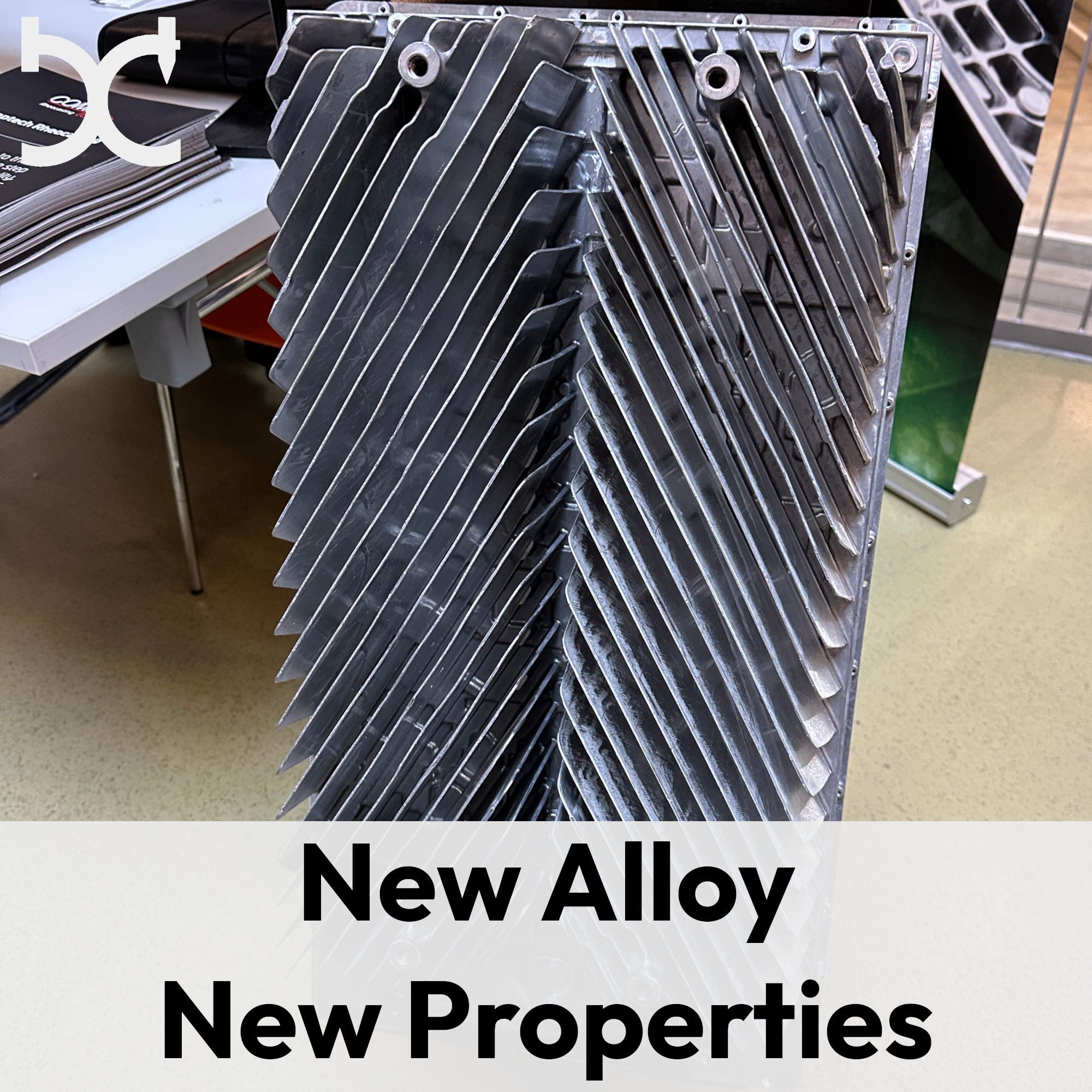
Take a look at the heat sink below. It is the back of a massive 5G antenna for Ericsson. It features high, angled fins tilted toward one another to generate turbulence in the airflow. To get these fins cast, you need an alloy with excellent castability. Good castable alloys have high silicon contents and insufficient heat conductivity for application. The heat conductivity of the aluminium is the limiting factor in the range of these antennas. Range becomes the deciding factor when you need a network for whole countries.
For this part, an AlSi2.5FeMg was designed and selected for this application. The alloy has a carbon footprint of 0.36 kg CO2e per kg Al, which results in just 9 kg CO2e for the whole casting from the alloy side. It saves 91 kg CO2 per casting made with the best primary alloy and 391 kg CO2 per casting made with the global average. In this quick calculation, additional antennas with lower range are not considered.
In High-Pressure Die-Casting, the AlSi2.5FeMg alloy is uncastable. However, it works flawlessly in Rheocasting, as you can see in the picture. The heat conductivity in the casting (not a test plate) reaches up to 198 W/mK. To put this into perspective, that is just 10% below pure aluminium.
Conclusion
Yes, changing an alloy causes complexity for the foundries, but it is the best solution to enable unseen properties. As a side note to the foundries, staying with commodity alloys means staying with commodity parts and commodity pricing.
Specialised alloys in combination with Rheocasting allow design owners to expand part functionality and foundries to break out of the price war. Let’s discuss what Rheocasting can do for your part spectrum.
Why your Product Features aren’t Resonating⚒️

In the foundry industry, product marketing often follows a predictable script. A new product is launched, a press release is written, and the focus is placed squarely on technical features. The announcement typically includes a few performance metrics, a quote from the CEO, and a link to the website. Then, nothing happens.
The problem is not the product; it is how the story is told.
Features are not Enough
Customers are rarely motivated by features alone. They are interested in how those features translate into real-world benefits. They want to know if a new control system will reduce downtime, improve yield, or help them meet tight customer deadlines.
Describing what a product does is not the same as explaining why it matters. When marketing focuses solely on specifications, it leaves customers to make that leap themselves, and most won’t.
To engage technical buyers, your message needs context. You need to explain the “why” behind your product, the problem it solves, and how it improves the customer’s workday. This is where storytelling becomes essential.
Podcasts offer the perfect format for this. In a 30 to 45-minute episode, you have time to provide depth, share background, and connect with your audience on a human level. Unlike a brochure or a post, a podcast allows your team to speak naturally and build credibility through conversation.
Speak to the Customer’s Reality
Many companies create content based on what they want to say. But effective marketing speaks to what the customer wants to hear. While you may be excited about a technical improvement, your audience is thinking about downtime, defect rates, and meeting production targets.
If your message does not address their concerns, it will not land, no matter how innovative the product may be.
The Goldcasting Podcast helps you share your story in a way that your customers actually want to hear. It turns product information into meaningful conversation. The format not only builds trust, but it also creates a long-lasting content asset. Podcast episodes remain online, are easy to share, and can be repurposed into shorter clips, blog posts, or FAQs.
In an era when attention is hard to earn, a podcast is one of the few formats that can capture it and convert it.
Conclusion
If your marketing efforts are falling flat, consider this: the issue might not be your product, but how you’re communicating its value. Features are important, but they need to be connected to outcomes.
Tell the story behind your solution. Show why it matters. And if you need help doing that, the Goldcasting Podcast is here to help you share that message with the people who need to hear it.
Are Tier One Suppliers Losing Ground?⚒️
Tier one suppliers have long been the glue of the automotive industry, connecting OEMs with the foundries, managing subsystem production, and orchestrating complex supply chains. But with the rise of Gigacasting and a turbulent market backdrop, their role is being redefined. And not for the better.
The Double Squeeze on Tier Ones
Here’s the problem: many Tier One suppliers operate on razor-thin margins and heavy debt loads. They are often caught in the middle, squeezed by OEM cost-cutting on one side and rising production complexity on the other. Now add Gigacasting into the mix.
OEMs are integrating more casting operations in-house or establishing “shop-in-shop” setups with dedicated foundries nearby.
Foundries and OEMs directly collaborate, bypassing the traditional Tier One layer entirely.
Some Tier Ones themselves have invested in large Gigacasting machines, only to find their customers aren’t buying enough volume to keep them running.
This means that Tier Ones are now at risk of losing not only volume but their entire strategic relevance.
From Assemblers to Afterthoughts?
In a Gigacasting model, entire body sections that once required dozens of parts and subsystems assembled and supplied by Tier Ones are now consolidated into one massive casting. The structural component is simpler. The supply chain is shorter.
This is a structural threat for Tier Ones that specialize in assemblies made from multiple stamped, welded, or cast parts. They may find their core offering obsolete. And as OEMs look to lower costs and reduce dependencies, especially in an era of economic slowdown, the middleman becomes an obvious target.
Early Signs of Collapse
We’re already seeing cracks. German Tier One suppliers have begun slashing thousands of jobs. Some are now reportedly asking their suppliers to pay upfront just to stay in business with them; an unsustainable, if desperate, move.
In our view, the companies that produce “casting + stamping + cable” products, which are commonplace in EV subsystems, will be among the most brutally affected.
And while some OEMs may try to rescue key suppliers to avoid disrupting their own production, they will be selective. Not every Tier One will make the cut.
Reinvention or Obsolescence?
So what can Tier Ones do? They must reinvent. Fast.
Invest in technologies that are additive to Gigacasting, not redundant.
Form strategic alliances to retain value within a new structure.
Specialize in high-IP or subsystems outside the structural applications.
And most importantly: embrace engineering. The foundry world is shifting from “who assembles it” to “who knows how to make it work.”
What This Means for Foundries
For foundries, this is both a warning and an opportunity. If Tier Ones fall, foundries must be ready to step into direct OEM relationships and form new alliances to fill the gap. That requires business agility, technical depth, and a mindset shift away from commodity casting toward strategic manufacturing partnerships.
The foundries that succeed will be the ones that think like problem solvers, not just production plants.
Thank you for listening. We’ll see you in the next episode, where we’ll continue to bring you the latest insights and updates from the casting world. Don’t forget to ask questions, comment, or suggest future episodes.
Offers from Casting-Campus GmbH
Casting-Campus is all about helping you acquire new business through intelligent solutions, new technologies like Rheocasting, and sustainability.
Our services start with positioning your foundry. The next steps are to find unique solutions to market to existing and new customers and generate new profitable castings. In the meantime, we will improve your internal processes to accommodate the new solutions in your foundry. During the sampling process, we’re by your side, pushing the buttons to deliver the properties promised in the development process.
Workshops on HPDC process optimization, Rheocasting and Sustainability
Business Development to acquire new Customers in the Foundry Industry
Strategy Development for Rheocasting and Sustainable Castings
Casting Experts on Demand - The Netflix of Knowledge
Support for part development: address casting issues early in the design process
If this sounds appealing to you, visit the website for more information on the Consulting Services and schedule a Free Consultation Call. Let’s discuss what the right solution is for your topic of interest:
Historical Post
A weekly reminder of an old but gold article
Rheocasting is no Golden Paint - Part 2⚒️
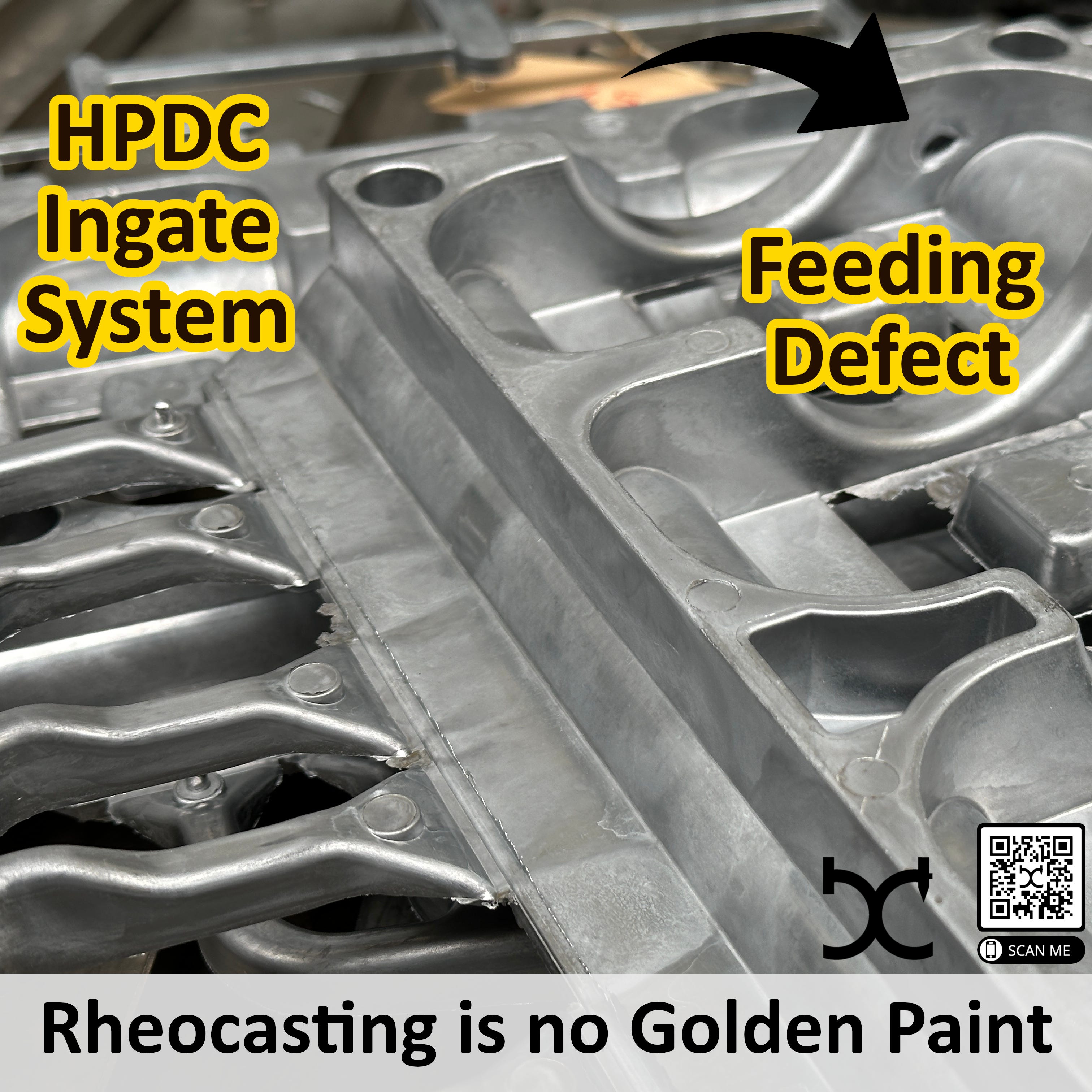
Implementing new technologies is always complex, as the surroundings must be adapted. In last week’s article, I described the issues with the standard HPDC ingate in Rheocasting. In the picture, you can see exactly the negative effects.
HPDC Ingates in Rheocasting
The part shown below has the normal HPDC ingate that spreads out in individual fingers. Then, it thins down even more before connecting to the part. The intention is to figuratively spray the melt into the part. That works excellently for liquid HPDC, and you can also cut it with the trim press.
But Rheocasting is a different animal. Rheocasting uses a slurry with thixotropic properties. These thixotropic properties allow for slow, laminar filling of the part with outstanding properties.
However, the liquid and solid particles are segregated when you force this thixotropic slurry through a thin HPDC ingate. You also create surfaces that cannot recombine due to oxidation, and they also entrap air.
The picture below shows how the HPDC ingate limits the effectiveness of the Rheocasting process. The large feeding pore on the surface is visible. An X-ray image of the part would show even worse properties.
Just so you know, this part is not a series production part. It is the training part of the Bühler Application Center in Uzwil, explicitly designed to show feeding issues. And, of course, they know exactly how to design a Rheocasting ingate, which has already been built. It was just a trial to show the detrimental effect on the casting quality.
What does an Ingate for Rheocasting look like?
When working with thixotropic fluids, the worst thing to do is break the surface of the slurry. So, your ingate has to keep the slurry-front as uniform as possible. So, instead of splitting the gate into individual fins, it has to be a more uniform gating, looking like a whale tail.
This way, the slurry stays compact and fully utilises the shear forces, the pocket warmer effect, and the laminar fill. This gives you the perfect properties for your casting!
You would also turn the shown casting 90 degrees to fill the thickest areas first and have the best solidification path possible. But that would make a terrible training tool, as the filling works perfectly.
Level up your castings!
Do you want to learn more about how Rheocasting can be an asset for your foundry to level up production and acquire new business? Or do you want to see how Rheocasting can solve your design limitations (high wall thickness, long flow length, or leakage requirements) for castings? Book a free consultation today and learn what Rheocasting can enable for you: