
Rheocasting vs. Squeeze Casting⚒️
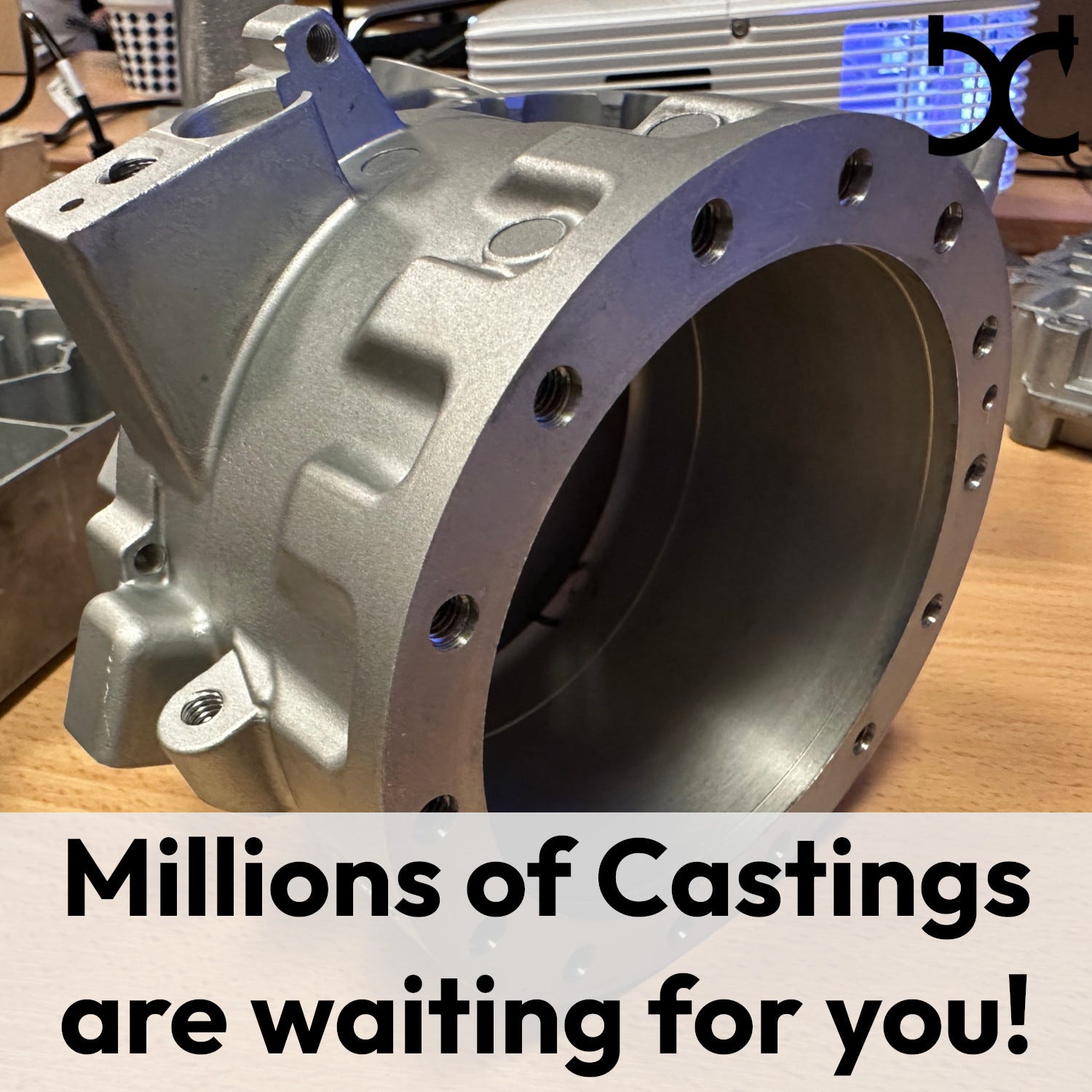
Learn how the F-Gas-Ban hands you millions of castings for your small machines

This week’s newsletter contains the following topics:
CO₂ (R-744) systems operate at markedly higher internal pressures than the traditional R-134A refrigerants, so even small, interconnected pore networks that were once tolerated in conventional HPDC are now causing leak failures.
Squeeze casting solidifies a fully liquid charge under high external pressure inside a closed, pre-heated die. The applied pressure enhances metal–die contact, refines the microstructure, and continuously feeds hot spots as they solidify, thereby eliminating shrinkage porosity, the root cause of leakage.
Squeeze casting imposes a pressure hold on every shot and therefore operates in the minutes-per-cycle regime for typical automotive aluminum parts; that pressure-time is exactly what delivers its shortcoming in high-volume production.
Two squeeze-casting modes are used. Direct squeeze casting pours into an open lower die and then presses directly on the melt, enabling very high in-cavity pressure and superb feeding on chunky sections.
Indirect squeeze casting injects through a shot sleeve and thick gates at low speed, improving reach into more complex features, but with some pressure loss across the gate.
Economics retire Squeeze Castings
Squeeze casting, as well as Rheocasting, eliminates porosity-driven scrap. Rheocasting’s approach to the F-Gas Ban programmes lies in the efficiency. Rheocasting as a retrofit solution on existing HPDC machines with a slurrymaker, tooling adjustments, and tuned shot profiles scales quickly across multi-machine cells and supports automotive volumes in the millions with limited capex.
Squeeze casting requires dedicated presses capable of sustaining high squeeze loads and longer holds; it is therefore a better economic fit for small volumes. Additionally, a higher machining allowance and longer milling time are required to achieve the required tolerances.
When part numbers reach the millions per year, efficiency and, consequently, pricing become key factors. Cycle times of multiple minutes for a single part require an armada of squeeze casting machines to keep up with the Rheocasting process on an HPDC machine.
For HPDC foundries, this opens up an entirely new field of high-volume applications, as the start date for F-Gas Ban-compliant compressors is stipulated in EU law. From 2026 on, every new vehicle platform needs a new climate system. The current suppliers are unable to deliver the required leak-tightness from their HPDC process.
Additionally, this is the application for your small machine segment, which has been starved of profitable contracts long before the current sales crisis.
Rheocasting as a Business Development Tool
The first foundry has already begun switching over its production and presented its line of Rheocasting compressor housings in Japan. Some European foundries have also tried to capitalize on that market segment, but failed in their trials.
The bottleneck is not the technology. The difference was in the preparations and implemented processes before the trial even started. If you don’t want to strike out with your business development, schedule a meeting on the website and learn more about the Rheocasting Expert on Demand.
Content that Attracts Customers, Talent, and Opportunities⚒️
If you work in the high-pressure die casting industry, chances are you build amazing things that almost no one outside your niche knows about. Our technology powers cars, electronics, and countless products yet to the world, we’re invisible.
That invisibility isn’t because our solutions lack value. It’s because we rarely discuss them in a way that the outside world understands. We remain quiet, relying on trade fairs and PDF press releases, and hope someone stumbles upon our website. Meanwhile, buyers are searching differently. They’re asking AI tools and specialized engines for answers. If we don’t publish fresh, useful content, we’re invisible both to humans and to the algorithms shaping purchasing decisions.
A Practical Solution: The Marketing Accelerator
That’s precisely why the Marketing Accelerator by Casting-Campus GmbH exists. It’s a free, industry-only community where foundry professionals learn how to market smarter: to create content that attracts the right customers, builds employer branding, and keeps our industry visible and competitive.
The Accelerator is not a classroom; it’s a living workshop. Every two weeks, members meet online to share what they’ve posted and receive real feedback, learn how to make technical content resonate with decision-makers, swap strategies for LinkedIn, blogs, and other platforms, and hold each other accountable, because consistency is the hardest part.
No marketing agencies are trying to sell something, and no sales pitches; just peers helping peers grow.
“It Changed My Perspective and My Career”
Podcast co-host Staffan Zetterström knows firsthand what creating content can do:
“First of all, I’ve met so many interesting people. Some I now call friends because we keep meeting at trade fairs and in discussions. Second, it constantly challenges me. I have to reframe ideas, think creatively, and communicate so others really understand. Honestly, I think it keeps my mind young and inventive. Without it, I’d probably still stand at Euroguss every two years with the same old brochure, complaining that nothing new is happening.”
Content opened doors for Staffan to new networks, new learning, and new business opportunities. That same growth is what the Marketing Accelerator is designed to unlock for you.
Why You Should Join Now
It’s free to join, safe from sales pressure, and practical rather than theoretical. It’s more relevant than ever as AI reshapes how customers search for suppliers.
If you’ve ever felt your company deserves more recognition, if you want better leads, stronger recruiting, or even a stronger personal brand, this is your moment. Stop leaving world-class work “in the drawer.” Join a group that’s learning, sharing, and building the public face our industry has always deserved.
Schedule a Free Consultation Call to learn more about the Marketing Accelerator on the website.
Making the invisible Industry visible⚒️
For decades, the high-pressure die casting industry has been a silent force behind modern life. Our parts are the building blocks of cars, and enable entire product categories; yet, outside our bubble, almost nobody knows what we do. Step into a casting trade fair booth and you’ll meet brilliant engineers, but step outside, and the wider market remains unaware that die casting could solve their challenges.
This invisibility isn’t about poor technology
Our industry today bears a striking resemblance to Kodak in the 1970s. Kodak engineer Steve Sasson invented the first digital camera, an innovation that could have reshaped the company’s future. But Kodak never marketed it. Executives, focused on film sales, didn’t understand how to explain or monetize the breakthrough. They shelved it, and when digital photography took off, Kodak lost the market it could have owned.
Many foundries risk the same fate. We develop incredible tools and processes, but fail to translate them into stories the outside world can understand. Engineers think in tolerances and alloys; buyers think in outcomes and business cases. A beautifully cast and machined part doesn’t sell itself if no one beyond our circle knows what it does, how it saves cost, or why it’s unique.
Traditional mass communication, such as a PDF press release uploaded to LinkedIn or a trade-show brochure, doesn’t reach the right people.
Meanwhile, the way customers search is shifting: buyers now ask AI tools and specialized engines for answers. These tools surface blog posts, white papers, and active, trusted websites, not static homepages. If your online presence is silent, you’re invisible not just to people but to the algorithms shaping procurement.
Content Marketing is the Key
Consistent, high-quality articles, videos, and case studies position your company where potential customers are already looking. They educate, build trust, and bring qualified leads who already understand what you offer, instead of forcing you to cold-call 100 strangers for one reply. Strong content also attracts talent: a younger workforce wants to see an innovative, visible, forward-thinking industry.
Most importantly, content is how a specialized sector like ours can claim space in the global conversation. Tesla’s Gigacasting moment briefly put die casting on the mainstream radar, but we can’t rely on a single automotive headline. If we don’t tell our story, if we “keep the digital camera in the drawer”, someone else, or no one at all, will.
Thank you for listening. We’ll see you in the next episode, where we’ll continue to bring you the latest insights and updates from the casting world. Don’t forget to ask questions, comment, or suggest future episodes.
Offers from Casting-Campus GmbH
Casting-Campus is all about helping you acquire new business through intelligent solutions, new technologies like Rheocasting, and sustainability.
Our services start with positioning your foundry. The next steps are to find unique solutions to market to existing and new customers and generate new profitable castings. In the meantime, we will improve your internal processes to accommodate the latest solutions in your foundry. During the sampling process, we’re by your side, pushing the buttons to deliver the properties promised in the development process.
If this sounds appealing to you, visit our website for more information on Consulting Services and to schedule a Free Consultation Call. Let’s discuss what the right solution is for your topic of interest:
Historical Post
A weekly reminder of an old but gold article

Where does Tool Wear come from?⚒️
Aluminium HPDC dies endure extreme conditions, facing thermal, mechanical, and chemical stresses with every production cycle. These stresses can lead to various forms of wear, compromising the die’s lifespan and the quality of the parts produced. Let’s dive into the main factors influencing die wear and explore practical solutions to extend die life.
There are three major culprits:
Chemical Attack
Erosion and Abrasion
Thermal Fatigue
Adhesive wear or soldering occurs when aluminium adheres to the die surface, making it challenging to release parts and increasing maintenance downtime. In addition, areas around the gate suffer from erosion due to the direct metal impact, while cavitation wear results from void collapses within the die material. But this article is not about these two factors. The easiest way to avoid these is using Rheocasting.
This article is about thermal fatigue, which causes cracks on the tool steel’s surface. These heat checkings are filled with aluminium with each shot. The crack imprints must be deburred from each part in the post-processing, which triggers additional costs.
Where are these cracks coming from?
The surface getting in contact with the aluminium heats the most. Each millimetre below sees a lower temperature until you reach the temperature of the cooling system. The temperature difference between the surface and the cooling channels defines our temperature range in the tool. When we multiply that with Young’s modulus and the thermal expansion coefficient, we can calculate the stress:
σ=E⋅α⋅ΔT
So, each degree of temperature difference you save reduces the stress on the tool’s surface. As mentioned in Gold Nugget 22, tool steels are designed to reach 150 to 250°C consistently. Therefore, avoiding cold cooling water is the first step to significantly improving your tool’s lifetime. Usually, these require a redesign of the cooling channels to achieve a consistent temperature throughout the mould. However, when you use a lot of cold water, you will need that new tool sooner or later anyway.
The second step is to improve the spraying process. Cooling hot spots by spraying cold water on them is a terrible idea. Due to the Leidenfrost effect, you will not reach the hot surface, thereby not impacting the hot spot. Instead, you cool colder areas even further down. This can result in water not evaporating until the melt hits it, causing porosity issues or preventing the lubrication from forming a protective layer, bringing soldering issues to your die far away from the hot spot.
What are the most effective solutions to prevent tool wear?
Training your development and production teams on the principles of thermal fatigue will yield the highest ROI in prolonging the tool’s lifetime. By implementing the “no water” rule, even Gigacasting tools can reach over 100,000 shots. We can also explore heat treatments that heal your tool before the cracks form. You will also get more tips and tricks for your HPDC production and information on why Rheocasting extends the tool’s lifetime even further.